
Why Every Restaurant in Arkansas Needs to Take Grease Traps Seriously
Picture this: it is a Friday night, your dining room is packed, orders are flying out of the kitchen, and suddenly a foul sewer odor fills the entire building. Within minutes, murky water backs up through your floor drains. Customers leave. You lose thousands of dollars in a single evening. We have seen this scenario play out more times than we can count across Central Arkansas, and the culprit is almost always the same — a neglected grease trap. At SOS Plumbing, our team specializes in commercial grease trap cleaning services designed to keep restaurants, cafeterias and schools, and every type of food service business running without interruption. In this article, we are pulling back the curtain on how grease traps work, what goes wrong when they are ignored, and exactly how our commercial grease trap cleaning services in Central Arkansas protect your bottom line, your reputation, and your compliance standing.
Understanding Grease Traps and Why They Matter for Commercial Kitchens
What Exactly Is a Grease Trap?
A grease trap — sometimes called a grease interceptor — is a plumbing device installed between your kitchen drain lines and the municipal sewer system. Its sole purpose is to capture FOG (fats, oils and grease) before those substances enter the public wastewater infrastructure. When hot cooking oil, butter, lard, or meat drippings wash down your commercial kitchen sink, they cool as they travel through the plumbing. As they cool, they solidify and cling to pipe walls. A properly sized and maintained grease trap intercepts that FOG before it causes a blockage.
We install grease traps ranging from small under-sink units for modest food service businesses to large in-ground grease interceptors that serve high-volume commercial kitchens. Regardless of size, the principle is the same: FOG floats to the top inside the trap, solids settle to the bottom, and the relatively clean water in the middle flows onward to the sewer.
The Real Cost of Ignoring Grease Trap Maintenance
Many restaurant owners treat grease trap maintenance as an afterthought — something they will get to “next month.” But every week of delay compounds the risk. Here is what we have witnessed across Arkansas when grease traps go unchecked:
– A single clogged grease trap at a North Little Rock barbecue restaurant led to $14,000 in water damage after sewage flooded the kitchen overnight.
– A Cabot café failed a surprise health inspection because FOG buildup exceeded the 25-percent rule, resulting in a temporary closure and devastating online reviews.
– A Sherwood franchise location suffered repeated sewer backups that required emergency drain cleaning and sewer repairs, ultimately costing three times what routine grease trap pumping would have totaled over the same period.
The financial math is brutally simple. Scheduled grease trap cleaning costs a fraction of what you will pay for restaurant plumbing emergencies, lost revenue, health code fines, and structural water damage. Our commercial grease trap cleaning services exist specifically to help you avoid every one of those nightmare scenarios.
How FOG Causes Sewer Backups Across Entire Neighborhoods
When FOG escapes an unmaintained grease trap, it does not just affect your building. It accumulates inside municipal sewer mains, forming massive blockages sometimes called “fatbergs.” These fatbergs cause sewer backups that can impact neighboring businesses, residences, and stormwater systems. Municipal wastewater regulations exist in part to prevent exactly this chain of events. Municipalities across Arkansas — including Jacksonville, Lonoke, and Ward — actively enforce grease trap regulations and can levy substantial fines against food service businesses that allow FOG to enter the public system unchecked. When we perform grease interceptor cleaning for our clients, we are protecting not just their plumbing but the broader community infrastructure as well.
Commercial Grease Trap Cleaning Services: What Our Process Looks Like
Step-by-Step Grease Trap Pumping and Cleaning
We have refined our grease trap cleaning process over years of serving restaurants and commercial kitchens throughout Central Arkansas. Here is exactly what happens when our SOS Plumbing grease trap services team arrives at your location:
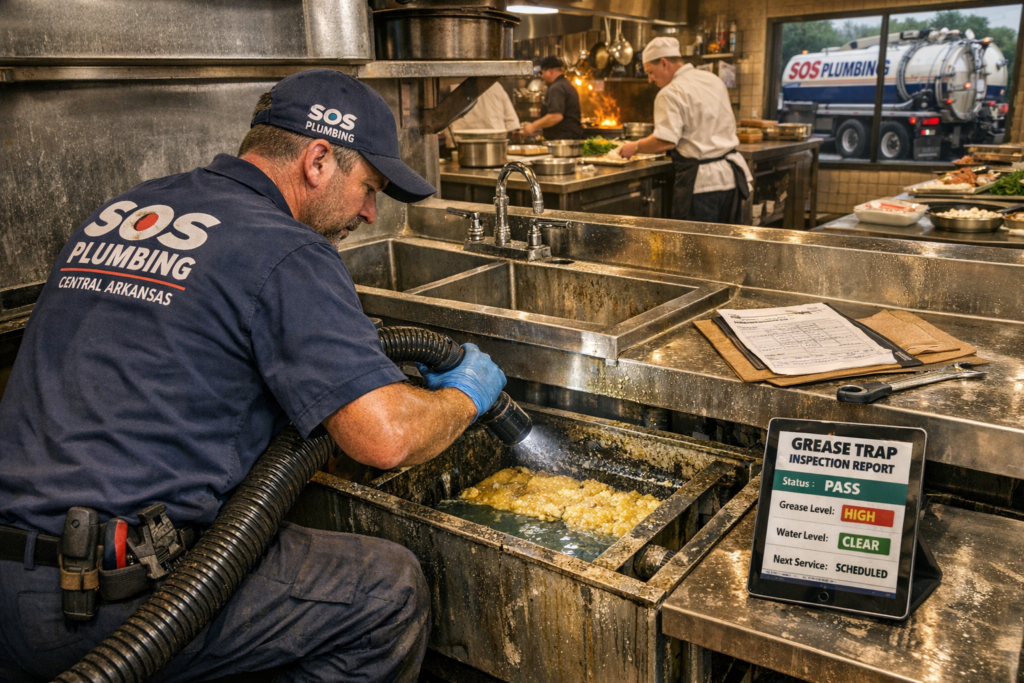
1. Initial inspection – We open the grease trap, measure the FOG layer and settled solids, and document the findings in a grease trap inspection report. This service log becomes part of your permanent compliance record.
2. Grease trap pumping – Using our industrial vacuum truck, we pump out all FOG, wastewater, and solid debris from the trap. We never leave residual buildup behind because partial cleaning leads to premature re-clogging.
3. Scraping and scrubbing – After pumping, our technicians manually scrape the walls, baffles, and crossover pipes inside the trap. This step is what separates professional commercial grease trap cleaning services from the shortcuts some vendors take.
4. Component check – We inspect inlet and outlet tees, baffles, and seals. If we spot cracked components or signs of corrosion, we recommend repair or grease trap installation of replacement parts before a small issue becomes a full-blown restaurant plumbing emergency.
5. Refill and test flow – We refill the trap with clean water, run water through the system, and confirm proper flow and seal integrity.
6. Documentation – You receive a detailed grease trap inspection report including before-and-after photos, measurements, recommended service interval, and any compliance notes. Property managers and facility managers appreciate this documentation because it simplifies audits and lease compliance verification.
How Often Should Grease Trap Cleaning Happen?
The answer depends on your volume, menu, and trap size, but here are the general guidelines we follow:
– High-volume restaurants (fried food, heavy sauces): every 30 to 60 days
– Moderate-volume restaurants and cafeterias and schools: every 60 to 90 days
– Low-volume food service businesses (coffee shops, bakeries): every 90 to 120 days
– Large in-ground grease interceptors: quarterly, with monthly inspections
We always recommend scheduled grease trap inspections between full cleanings. A quick inspection catches rising FOG levels before they trigger a clogged grease trap situation. Our commercial plumbing services team can set you up on an automated schedule so you never have to worry about remembering the next appointment.
Grease Trap Regulations, Health Code Compliance, and Staying Out of Trouble in Arkansas
What Arkansas Municipalities Require
Grease trap regulations vary slightly from one jurisdiction to another across the state, but the common thread is clear: if you operate a commercial kitchen, you must have a functioning, properly maintained grease trap or grease interceptor. Most municipal wastewater regulations in Central Arkansas stipulate the following:
– Grease traps must not exceed 25 percent FOG accumulation by volume at any time.
– Food service businesses must maintain a service log showing dates, volumes pumped, and the name of the licensed hauler.
– Grease trap installation must meet local plumbing code specifications, including minimum sizing based on fixture flow rates.
– Facilities are subject to unannounced inspections by municipal code enforcement.
Failure to meet these standards can result in fines starting at several hundred dollars per violation, mandatory corrective action orders, or even temporary closure. We have helped restaurants in Jacksonville and Lonoke navigate surprise inspections simply because they already had up-to-date service logs from our regular grease trap maintenance visits.
Health Code Compliance and Your Reputation
Health code compliance is about more than avoiding fines. In the age of online reviews, a single health department violation becomes public knowledge within hours. Bad odors wafting into the dining room, visible sewage near prep areas, or a closure notice taped to your front door can undo years of brand building overnight.
Our SOS Plumbing grease trap services approach is proactive. We do not wait for problems to appear. We establish a grease trap maintenance calendar tailored to your specific operation, conduct scheduled grease trap inspections, and keep your compliance documentation audit-ready at all times. For property managers overseeing multi-tenant commercial spaces, we provide consolidated reporting so you can verify that every food service tenant is meeting environmental compliance obligations.
Environmental Compliance and Community Responsibility
Beyond local codes, there is a broader environmental compliance dimension. FOG that enters waterways contributes to oxygen depletion, harms aquatic ecosystems, and can trigger violations of the federal Clean Water Act at the municipal treatment plant level. When a city faces those penalties, they often pass enforcement pressure downstream to the commercial kitchens that contributed to the problem. Investing in regular FOG removal through professional grease trap pumping is one of the most straightforward ways a restaurant owner can demonstrate environmental stewardship while also shielding themselves from regulatory blowback.
Choosing the Right Partner for Commercial Grease Trap Cleaning Services in Central Arkansas
What to Look for in a Grease Trap Service Provider
Not every company that owns a pump truck delivers the same level of care. Here is what we believe separates outstanding commercial grease trap cleaning services from bare-minimum vendors:
– Licensed and insured commercial plumbing services with specific grease trap expertise
– Full-service capability including grease trap pumping, grease trap cleaning, grease interceptor cleaning, grease trap installation, and drain cleaning and sewer repairs
– Transparent documentation with a grease trap inspection report after every visit
– Flexible scheduling that accommodates restaurant hours — because a pump truck parked at your front door during the lunch rush is not ideal
– Local knowledge of grease trap regulations in your specific municipality
– Emergency availability for restaurant plumbing emergencies, sewer backups, and urgent drain cleaning and sewer repairs
We built SOS Plumbing around these exact principles. Our service area covers grease trap cleaning in Central Arkansas comprehensively, including North Little Rock, Cabot, Sherwood, Jacksonville, Lonoke, and Ward. Whether you run a single family-owned diner or manage a portfolio of commercial properties with multiple food service tenants, we scale our commercial grease trap services to fit.
Why Facility Managers and Property Managers Trust SOS Plumbing
Facility managers and property managers face a unique challenge. They need to ensure that tenants comply with grease trap regulations without micromanaging every kitchen. We solve that problem by serving as a single point of contact for all grease-trap-related commercial plumbing services across a property or portfolio. Our team handles scheduling, performs grease trap maintenance on every unit, generates individual grease trap inspection reports, and flags any tenant whose system is approaching non-compliance. This turnkey approach has made us a preferred partner for property managers throughout Arkansas who oversee cafeterias and schools, strip-mall restaurants, and standalone food service businesses alike.
Preventive Maintenance Saves More Than Money
We often tell our clients that grease trap maintenance is not an expense — it is insurance. Consider the cascading consequences of a single clogged grease trap event:
– Immediate sewer backups that shut down kitchen operations
– Emergency after-hours call-out fees for drain cleaning and sewer repairs
– Water damage to flooring, drywall, and equipment
– Potential health code compliance violation and associated fines
– Negative customer reviews citing bad odors or unsanitary conditions
– Possible environmental compliance penalties from the municipality
Now compare that to the modest, predictable cost of routine grease trap pumping and scheduled grease trap inspections on a regular calendar. The return on investment is overwhelming. Every dollar spent on preventive grease trap cleaning saves an estimated five to ten dollars in avoided emergency repairs, lost revenue, and regulatory penalties.
Take the Next Step to Protect Your Business Today
Running a restaurant or food service operation in Arkansas is demanding enough without worrying about what is lurking inside your grease trap. We have spent this entire article unpacking the risks — sewer backups, foul sewer odor complaints, water damage, health code violations, and costly restaurant plumbing emergencies — because we genuinely want to help you avoid them. At SOS Plumbing, our commercial grease trap cleaning services are built on reliability, transparency, and deep local expertise in grease trap cleaning in Central Arkansas.
Whether you need your first grease trap installation, a one-time grease trap pumping to get back into compliance, or an ongoing grease trap maintenance program that keeps your commercial kitchen running smoothly year-round, we are ready to help. Our team proudly serves restaurants, cafeterias and schools, and food service businesses across North Little Rock, Cabot, Sherwood, Jacksonville, Lonoke, and Ward.
Do not wait for a clogged grease trap to turn into a full-scale plumbing disaster. Reach out to our team today and let us design a FOG removal and grease trap cleaning plan tailored specifically to your operation. Visit us at https://www.sosplumbingandrooter.com/ to schedule your consultation, request a free estimate, or ask any questions about our SOS Plumbing grease trap services. Your kitchen — and your peace of mind — will thank you.